



In semiconductor cleanrooms, a tightly controlled microenvironment is maintained. Temperature, humidity, floor vibration, cleanliness, airflow disturbance and other conditions interact with one another. Fluctuation of any environmental variable may be transmitted to the equipment base and evolve into nanometer-level benchmark deviation. During procurement and selection, many buyers tend to prioritize checking the flatness and dimensional tolerances of granite platforms, yet overlook the long-term environmental adaptability of the material itself. Geometric precision is merely a static indicator. Whether the platform can remain stable under the non-stop special operating conditions of the workshop all year round determines the success of granite platform selection.
Temperature condition is the primary factor for environmental evaluation. Although semiconductor workshops adopt constant-temperature systems, absolute zero fluctuation cannot be achieved. Continuous operation of equipment modules generates local minor temperature differences. Materials vary greatly in thermal response. Metal materials feature high thermal expansion coefficients, and slight temperature changes lead to obvious expansion and contraction. Inferior stone has abundant internal pores and may deform unevenly when heated. High-grade precision granite features a dense and stable crystal structure with minimal thermal deformation, which mitigates deformation caused by temperature gradients. Instead of only referring to inspection data obtained at room temperature, material selection should assess whether dimensional variation remains controllable within the allowable temperature fluctuation range of the workshop, so as to avoid platform warping induced by local temperature differences that damages the overall benchmark of equipment.
Next comes adaptability to humidity and clean environment. Semiconductor workshops are high-grade clean spaces with extremely strict control over dust and particles. Some stone materials have high porosity, which easily absorbs moisture and traps dust. Particles may slowly shed under airflow scouring inside the workshop, contaminating wafers and optical lenses and directly triggering yield failures. Material selection should examine the density of granite. Low-porosity materials hardly absorb water and will not expand or contract with humidity variation. Meanwhile, finely ground and sealed surfaces resist dust shedding. UNPARALLELED® black granite reaches a density of 3100kg/m³ with tightly bonded crystals and minimal pores. It can adapt to cleanrooms with constant long-term humidity and will not become a pollution source inside the clean workshop. In addition, the material boasts stable chemical properties and resists common cleanroom detergents, keeping the morphology of working surfaces unchanged without corrosion.
Vibration and foundation conditions of the workshop constitute another critical environmental adaptation factor. Factory foundation conditions differ significantly. Some workshops are close to air compressors and chillers; others are built on upper floors, resulting in distinct inherent vibration characteristics of the floor. Granite platforms possess inherent damping and vibration absorption capacity, yet their vibration reduction performance is correlated with self-weight, overall structure and workshop foundation. In the selection phase, the weight, thickness and structural form of granite components shall be matched according to measured on-site foundation vibration data. For certain projects, civil engineering solutions such as anti-vibration trenches and thickened foundations need to be coordinated with granite bases. Standard platforms cannot be simply copied. Even if granite itself meets precision requirements, it may fail to satisfy the demands of nanometer-level equipment in workshops with intense vibration.
Airflow disturbance inside workshops is another easily ignored factor. Laminar airflow is standard in cleanrooms. Continuous airflow exerts persistent pressure on the surface of large granite platforms and triggers minor force-induced deformation. For extra-long and extra-wide granite platforms, uneven pressure from airflow may cause slight deflection. Therefore, during material selection, the rigidity and dead weight of the platform shall be evaluated combined with laminar wind speed and equipment installation position in the workshop to reduce deformation caused by airflow pressure. For oversized granite components, stress status under laminar flow conditions should be considered at the design stage to guarantee that the benchmark surface will not shift under continuous airflow.
Long-term operational stability serves as another core dimension of environmental adaptation. Semiconductor fabs run 24/7 continuously. The workshop environment maintains constant temperature and humidity all year round, and equipment bases bear steady loads for a long time. Ordinary stone releases internal stress gradually over time and slowly deforms under cyclic temperature and humidity changes, leading to drifting precision year by year. Qualified precision granite undergoes sufficient aging treatment and contains nearly no internal stress. Its geometric shape can stay stable under the perennial constant temperature and humidity environment of workshops. Material selection needs to verify the aging process of materials and evaluate the magnitude of precision attenuation over decades of continuous constant-temperature and humidity operation, so as to guarantee stable equipment benchmarks throughout the full life cycle.
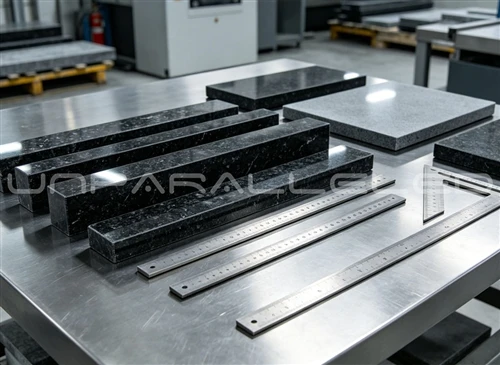
Another often-overlooked adaptation requirement relates to on-site handling, hoisting and spatial conditions of the workshop. Granite platforms supporting large semiconductor equipment feature large single-piece dimensions and heavy weight. It is necessary to evaluate workshop doorways, hoisting passages and crane load capacity. The load-bearing capacity of the floor and silent hoisting equipment inside the workshop must match the weight of granite components. If the floor bearing capacity of the workshop is insufficient, even granite platforms with high precision will suffer foundation settlement and indirectly destroy the benchmark. Hence, in the selection phase, the weight and segmentation scheme of platforms shall be determined according to civil engineering parameters of the plant, taking processing, transportation, on-site hoisting and installation conditions into account.
Beyond physical environment, metrology traceability and environmental verification of inspection also matter. The factory precision of granite platforms must be tested under constant-temperature conditions similar to customers' workshops. If the inspection environment differs greatly from the on-site workshop, precision will deviate after on-site installation. A full set of imported metrology instruments shall be adopted, complying with multiple international metrology standards. Inspections are completed in our constant-temperature, humidity-controlled and dust-free workshop simulating semiconductor workshop environments, ensuring factory indicators are reproducible under customers' actual working conditions.
Conclusion
Selecting granite platforms for semiconductor workshops is far more than purchasing a high-precision stone slab. It represents a complete environmental adaptation project covering material, structure and workshop operating conditions. Temperature gradients, humidity and cleanliness, foundation vibration, laminar airflow, long-term continuous loads and on-site hoisting conditions interact with each other and jointly determine the actual precision performance after the platform is put into service. Only by fully evaluating all environmental conditions and matching high-density, low-porosity and low-deformation precision granite can the equipment benchmark remain stable for a long time in the stringent cleanrooms of semiconductor manufacturing, supporting continuous and stable chip production.