



Choosing the material for a precision machine base is one of those decisions that looks simple in a datasheet and becomes complicated the moment real requirements appear: thermal drift targets, vibration sources, budget, weight limits, and delivery pressure all pull in different directions. Granite, cast iron, mineral casting, and engineering ceramics each dominate certain niches for good reasons, and none of them wins everywhere. This overview compares the four materials side by side, describes where each one fits best, and honestly states its limits, so that engineers and purchasing teams can shortlist the right candidates before requesting quotations.
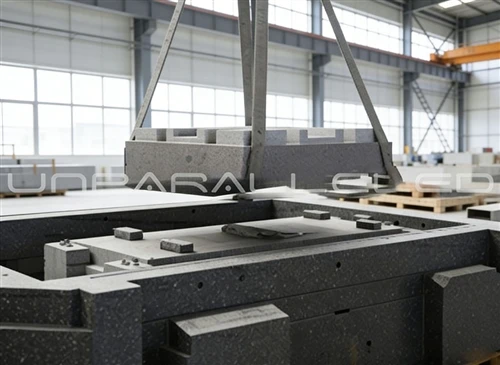
Quick Comparison Table
| Property | Granite | Cast Iron | Mineral Casting | Engineering Ceramic |
| Thermal stability | Low expansion, approx. 5-7 x 10⁻⁶/K | Higher expansion, approx. 10-12 x 10-6/K | Very low, approx. 4-8 x 10⁻⁶/K depending on mix | Lowest range for alumina and silicon carbide, approx. 3-5 x 10⁻⁶/K |
| Damping | Very good, natural grain structure | Moderate | Excellent, often several times better than iron | Good but brittle-controlled |
| Static rigidity | High, especially in thick sections | High and predictable | Good, section-dependent | Very high stiffness-to-weight |
| Weight | Heavy, approx. 3,070 kg/m³ | Heavy, approx. 7,200 kg/m³ | Moderate, approx. 2,300-2,500 kg/m³ | Light relative to stiffness, alumina approx. 3,900 kg/m³ |
| Cost | Moderate; raw block availability matters | Low for standard sizes | Moderate; mold amortization helps volume | Highest, machining drives cost |
| Lead time | 3-10 weeks typical, block sourcing critical | Long for new castings, short from stock | Mold making adds weeks, then fast repeats | Longest for ground and lapped parts |
| Typical equipment | CMMs, metrology tables, laser and semiconductor bases | Conventional machine tools, printing, packaging | High-speed machining spindles, automation bases, medical equipment | Ceramic gantry components, wafer handling, vacuum systems |
Figures above are typical ranges for common commercial grades; specific alloys, mixes, and ceramic compositions vary by supplier and should be confirmed in datasheets for your design.
Granite: The Metrology Benchmark
Fine-grained natural granite has been the reference material for metrology equipment for decades, and the reasons are easy to list. It is thermally stable, naturally damped, corrosion-free, and can be lapped to flatness grades that machined metals cannot economically reach. A lapped granite machine base arrives flat, holds its geometry for years, and never rusts in a humid lab. It is also repairable: a worn or damaged plate can be relapped instead of replaced.
Granite fits best where flatness and stability are the core requirementâmeasuring machines, optical inspection systems, laser processing platforms, and the reference tables of semiconductor equipment. Its limits are equally real. It is heavy, which complicates handling and increases frame requirements, and a typical granite machine base cannot be welded or bent; every feature must be machined or inserted. Lead time depends on block availability, especially above two meters. And in high-volume production of identical parts, casting or molding processes can undercut it on unit cost.
Cast Iron: The Proven Workhorse
Cast iron remains the default for conventional machine tools, and no comparison article is honest without saying why. It is inexpensive in standard sections, its properties are understood by every machine designer, it can be cast into complex ribbed shapes, and it tolerates impact better than any brittle material. For milling machines, lathes, and presses that work at normal precision levels, iron is usually the rational choice.
The limitations show up as precision demands rise. Its thermal expansion is roughly double that of granite, so thermal drift management falls on the cooling system and the machine design. Its damping capacity, while acceptable, is far below mineral casting. Castings have long lead times for new patterns, and the material can rust without protection. Hand-scraping to precision flatness is increasingly rare and expensive, which pushes most ultra-precision designs toward other materials.
Mineral Casting: The Modern Contender
Mineral casting, also called epoxy granite or polymer concrete, combines engineered aggregates with an epoxy binder poured into molds. Its strongest card is damping: published comparisons typically show several times the damping of cast iron, which directly improves surface finish and reduces settling time in high-speed motion. It is thermally stable, non-corrosive, and can integrate inserts, conduits, and mounting features directly into the pour. When comparing mineral casting vs granite for high-volume equipment such as automation bases, medical devices, and spindle housings, the molded process also scales economically once the tooling is amortized.
Its weaknesses deserve equal attention. Flatness straight out of the mold does not reach lapped granite grades, so critical datum surfaces usually receive a granite or metal plate bonded or bolted on afterwards. Mold tooling costs make prototypes and one-offs expensive. The material's stiffness is lower than steel or granite in thin sections, and long-term creep under sustained high load, while small, is a factor that designers of metrology-grade equipment still prefer to avoid.
For equipment builders weighing these trade-offs, a look at a working mineral casting production line shows where the process shines: repeatable mid-to-large series where damping and corrosion resistance matter more than sub-micron molded flatness.
Engineering Ceramics: When Nothing Else Survives
Alumina and silicon carbide ceramics occupy the extreme end of the precision world. Their stiffness-to-weight ratio is outstanding, their thermal expansion is the lowest of the four, and they hold geometric precision in vacuum, cleanroom, and high-temperature environments where metals and polymers outgas or drift. Ceramic gantry components and wafer-handling arm parts in semiconductor tools are the classic examples: light, stiff, and dimensionally frozen.
The constraints are cost and brittleness. Raw parts are expensive, and diamond grinding of every functional surface dominates the final price. Ceramics tolerate compression well but handle tensile stress and impact poorly, so designs must avoid stress concentrations and shock loading. Lead times are the longest of the group. In practice, ceramics are selected when the physics of the process leaves no alternative, not as a general-purpose base material.
How to Decide: Five Practical Questions
- What flatness does the working surface actually need? Lapped granite leads for direct lapped datums; mineral casting usually needs a bonded or bolted datum plate.
- What is the dominant vibration source? Strong damping favors mineral casting and granite over iron.
- How many units will you build? One-offs and low volume favor granite and iron; hundreds of identical bases favor mineral casting.
- What are the weight and dynamics limits? Ceramics win stiffness per kilogram; iron loses it.
- What environment will it live in? Humidity, coolant, and vacuum each eliminate different candidates quickly.
Frequently Asked Questions
Which material is best for a CMM base?
Lapped granite is the established choice because the working surface itself must be the flat reference. Its thermal stability and damping support nanometer-level measurement, and it can be relapped when needed instead of replaced.
Is mineral casting better than granite for damping?
In most published comparisons, mineral casting damps vibration several times better than granite, and far better than cast iron. Granite counters with higher stiffness and the ability to be lapped directly to sub-micron flatness, which is why many designs combine the two.
Why not use cast iron for everything?
Cast iron is economical and tough, but its thermal expansion is roughly double that of granite or mineral casting, its damping is lower, and precision flat surfaces require rare hand-scraping skills. As accuracy requirements tighten, the total cost of achieving flatness shifts the balance toward other materials.
Can granite and mineral casting be combined in one base?
Yes, and it is a common hybrid: a mineral-cast body for damping and weight reduction, with a lapped granite plate bonded or bolted on as the functional datum. This gives each material the job it does best.
Moving from Comparison to Quotation
The fastest way to settle the material question for your own machine is to put the same requirements in front of suppliers of each candidate and compare the returned engineering proposals, not just the prices. A useful quotation request states the envelope, flatness or straightness targets, load map, quantity, and environment, and asks each supplier to flag where their material needs design support. If your shortlist includes granite or mineral casting, you can request a manufacturability review directly from the factory with your outline drawingâthe response usually includes practical suggestions on section design, inserts, and datum strategy that make the final decision much easier.