



In the semiconductor industry, the pursuit of "smaller, faster, and more efficient" has pushed manufacturing tolerances into the sub-nanometer regime. As nodes shrink toward 2nm and beyond, the mechanical stability of the equipment-lithography tools, wafer probers, and ion implanters-becomes the ultimate bottleneck. Even the most advanced optical sensors or robotic actuators are rendered useless if their mounting frame vibrates, warps, or expands.
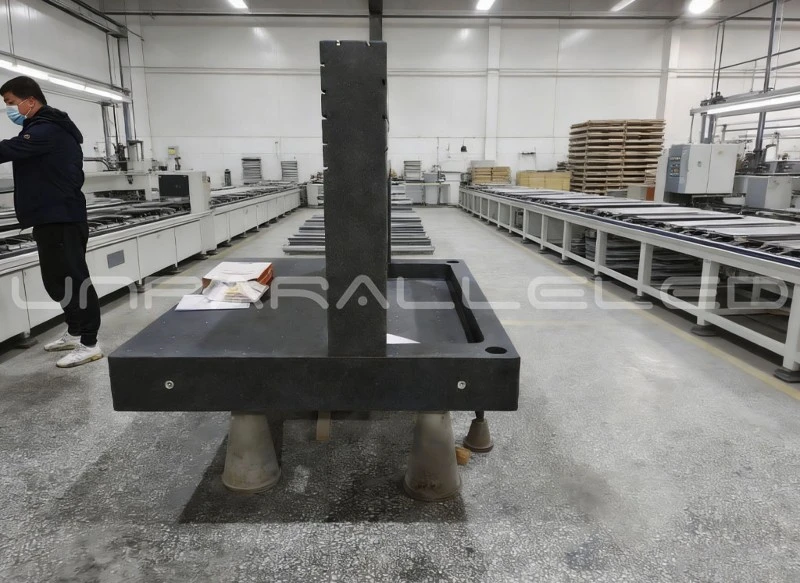
This is why the industry has shifted away from traditional metallic frames in favor of Custom Granite Structures. No longer just a "table," granite has become a critical functional component of the semiconductor ecosystem.
The Nanometer Challenge: Why Metal Fails
Historically, high-grade aluminum or steel alloys were used for machine frames. However, in the context of semiconductor fabrication, these materials possess three "fatal flaws":
High Thermal Expansion: Metals expand and contract rapidly with even the slightest temperature fluctuation caused by the cleanroom's power electronics or laser sources.
Internal Stress: Machining a metal frame introduces internal stresses. Over months or years, the metal "relaxes," causing the structure to warp slightly-enough to ruin the alignment of a wafer stepper.
Resonance: Metals are excellent conductors of vibration. A motor hum at one end of a machine can resonate through a steel frame, creating "blur" in high-resolution lithography.
1. Thermal Inertia and Coefficient of Expansion
Semiconductor cleanrooms are strictly climate-controlled, yet "local" heat is unavoidable. High-speed linear motors and UV light sources generate heat signatures that can cause micron-level shifts in equipment.
Custom granite structures offer a coefficient of thermal expansion (CTE) that is roughly 25% that of aluminum. Furthermore, granite is a thermal insulator with massive density. It possesses high thermal inertia, meaning it absorbs heat very slowly. For a wafer inspection tool, this means that even if a nearby component heats up, the granite base remains stable, ensuring that the spatial relationship between the wafer and the sensor remains constant throughout the process cycle.
2. Superior Vibration Damping for Nanometer Precision
In semiconductor lithography and wafer probing, high-frequency vibrations are the enemy of yield. If a wafer stage vibrates by even 10 nanometers during exposure, the resulting chip may be defective.
Granite is a naturally composite material consisting of quartz, mica, and feldspar. This crystalline structure acts as a natural damping mechanism. While a steel frame might "ring" like a tuning fork when a motor moves, granite "deadens" the energy.
Custom Geometric Optimization: Through custom engineering, we can design granite bases with specific thicknesses and ribbing to target and eliminate the harmonic frequencies of your specific motors and actuators. This leads to faster settling times-meaning the machine can move, stop, and take a measurement quicker, directly increasing your Units Per Hour (UPH).
3. Designing for Complexity: The Power of "Custom"
The word "Custom" is vital here. Modern semiconductor tools are not simple boxes; they require complex integration of vacuum lines, electrical conduits, and air-bearing rails.
Precision Machining and Inserts
Unlike standard surface plates, custom granite structures for semiconductors are intricately machined. We utilize high-precision CNC diamond-tooling to incorporate:
Threaded Stainless Steel Inserts: Vacuum-bonded into the granite to allow for the mounting of high-speed rails and optics.
Precision T-Slots and Guideways: Machined directly into the stone for air-bearing stages to glide over.
Internal Channels: For routing cables or coolant, keeping the cleanroom environment organized and reducing external "cable drag" interference.
By integrating these features into a single monolithic granite block, we reduce the number of bolted joints in the machine. Fewer joints mean fewer points of failure and less potential for mechanical "creep."
4. Chemical Inertia and Cleanroom Compatibility
Semiconductor fabs are highly sensitive environments. Outgassing from paints, oils, or oxidizing metals can contaminate an entire batch of wafers.
Zero Outgassing: Granite is a natural stone. It does not require painting, plating, or chemical coatings to prevent corrosion. It is naturally "cleanroom ready."
Chemical Resistance: During various stages of wafer processing, specialized chemicals or gases may be present. Granite is chemically inert and will not react with or be degraded by these substances, ensuring a service life that often exceeds 20 years.
5. The "Air Bearing" Interface
Most high-end semiconductor stages utilize air bearings to move the wafer. These bearings require a surface that is not only flat but also possesses a specific surface finish to maintain a 5-micron air gap.
Granite is the only material that can be reliably lapped to the extreme flatness (Grade 000) required for air bearings over large areas. The "closed-pore" nature of high-quality black granite ensures that the air film remains consistent, preventing "grounding" of the stage which could lead to catastrophic equipment damage.
Summary of Technical Advantages
| Feature | Steel/Aluminum | Custom Granite |
| Flatness Retention | Poor (warps over time) | Permanent (naturally aged) |
| Vibration Damping | Low | High (Crystalline structure) |
| Maintenance | High (Rust prevention) | Zero (Inert) |
| Customization | Welded/Bolted | Monolithic Machining |
| UPH Impact | Slow settling times | Rapid stabilization |
Conclusion: Foundation for the Next Generation of Chips
As the semiconductor industry moves toward EUV (Extreme Ultraviolet) lithography and advanced 3D packaging, the demand for mechanical "silence" has never been higher. A custom granite structure is no longer an optional luxury-it is a foundational requirement for any equipment manufacturer aiming for sub-5nm precision.
Investing in a custom granite base is an investment in yield. By reducing vibration, eliminating thermal drift, and providing a permanent reference plane, you ensure that your equipment delivers the performance it was designed for, day after day, in the world's most demanding manufacturing environments.