



When selecting structural components for large precision equipment, many engineers tend to focus merely on the overall density value of materials while overlooking uniform density, a hidden yet critical indicator. If density fluctuates within a single stone block, partial deformation differences will emerge under load. The reference surface may suffer slight distortion under heavy load. Even if the inspection passes at factory delivery, accuracy will gradually drift after long-term loading once installed. For CNC granite components, uniform density directly governs load distribution and serves as the fundamental prerequisite to guarantee stable long-term operation of heavy-load precision equipment.
Conventional granite or marble raw materials usually come with natural ore stratification and uneven distribution of mineral grains. During quarrying, a large raw block may contain loose interlayers and vein fractures, with obvious differences in mineral composition across zones. After being machined into beds or bases, high-density areas deliver high rigidity while low-density zones are relatively weaker. When continuous load is applied by worktables and moving modules of equipment, stress concentrates on weak regions and non-uniform micro-deformation occurs on the component. Invisible to naked eyes, such deformation directly impairs repeat positioning and linear motion tracks. Errors will multiply especially on gantry equipment and large-size inspection platforms. Many low-cost stone components meet standards in initial tests, yet their accuracy declines rapidly after a period of operation, rooted in non-uniform raw material density.
UNPARALLELED® black granite raw material undergoes strict ore screening and pre-inspection of large blocks. Mineral grain arrangement inside the whole block is controlled from the source to avoid interlayers, loose bands and local mineral veins. Density remains highly consistent across all regions of the raw block without locally loose or mineral-enriched zones. Its high density of 3100kg/m³ is not a single-point reading but a stable physical property throughout the entire block. When the granite base bears heavy objects and continuous pressure from moving parts, loads spread evenly along the component body without concentrated stress at single points, resulting in synchronous and controllable stress deformation.
The balanced load-bearing performance brought by uniform density delivers outstanding advantages for large-span and oversized integrated granite components. For parts such as extra-long gantry beams and large monolithic beds spanning over ten meters, load is distributed across a wide range. In case of uneven material density, bending deformation induced by self-weight will be asymmetric, creating a notable gap in reference flatness between no-load and full-load conditions. For CNC granite components with homogeneous density, self-weight deformation follows regular and calculable linear variation. Engineers can accurately predict deformation at the equipment design phase and complete structural compensation in advance, ensuring consistent reference accuracy under both no-load and full-load working conditions.
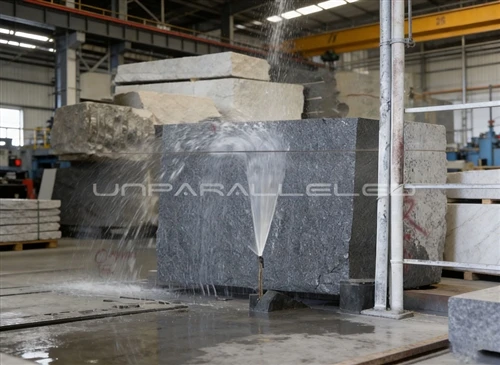
Granite with uniform density also performs well under dynamic alternating loads. Linear motor platforms and high-speed motion inspection equipment generate reciprocating alternating pressure constantly. With consistent internal density and uniform elastic modulus, stress waves transmit smoothly inside the material under cyclic loads. Stress reflection and local resonance at density mutation positions can be avoided. It reduces local micro-displacement under dynamic loads and suppresses reference disturbance caused by vibration, enabling stable positioning accuracy of motion platforms under continuous repeated loading.
Homogeneous raw material also brings benefits during machining. For stone with large density variation, material removal rate fluctuates in grinding and cutting. It becomes difficult for polishing technicians to control flatness and local height differences tend to appear. Granite with uniform density features stable and controllable material removal at a consistent rate during grinding, making it easier to achieve nanoscale planar benchmarks, lowering subsequent grinding correction workload and reducing residual stress induced by machining.
Metrology, semiconductor and new-energy inspection equipment work under diverse and complex load conditions, including static load from fixed counterweights and dynamic variable loads generated by reciprocating moving modules. Granite bases with homogeneous density will not warp locally under continuous bearing and alternating stress, maintaining stable deformation after long service life. Frequent shutdown for re-measurement and reference recalibration is unnecessary, cutting time costs for equipment maintenance. Such stable and balanced load capacity makes integrated granite components the ideal structural substrate for large-size, heavy-duty ultra-precision equipment.