



A precision granite machine base looks simple from the outside. It is a block of dark stone with flat faces and a few mounting holes. What decides whether it can hold a micron over ten years is not the colour but the material behind it, and how that material was selected, worked and measured. UNPARALLELED® builds its precision granite components from a high-density black granite with a density of about 3100 kg/m³, and supports that choice with traceable metrology and recognised management-system certifications. This article looks at why those three things - density, stability and traceable metrology - matter when you are specifying a precision granite structure.
Black granite is not the same as any black stone
Black granite and marble can look similar in a showroom and behave very differently in a machine. Marble is generally softer, more porous and more reactive to acids, and it is produced for decoration and architecture, where appearance is the priority. Precision granite is selected for the opposite reason: it is valued for stiffness, damping, dimensional stability and a surface that can be lapped flat and kept flat. When a supplier simply offers "black stone", the buyer has no way to know which one they are getting, and that uncertainty eventually shows up in the machine.
Density and homogeneity: where 3100 kg/m³ comes from
Density is the first measurable signal of what a granite can do. A denser stone usually means tighter grain packing, fewer internal voids and a more uniform structure, which in turn supports higher stiffness, better vibration damping and more predictable long-term behaviour. UNPARALLELED® works with black granite at a density of about 3100 kg/m³, a level that suits large, rigid and stable precision structures. Density alone is not the whole story, however. Homogeneity matters just as much, because a block with hidden cracks or inconsistent grain will not stay flat no matter how carefully it is ground. That is why raw stone is screened before it ever reaches a grinding machine.
Stability that can be verified, not just claimed
Stability is the quality that separates a reference from a heavy object. It has four practical parts: dimensional stability, so the part does not creep or change shape over time; thermal stability, so a modest change in room temperature does not move the geometry; damping, so vibration from the floor, a motor or a step nearby dies out quickly; and corrosion resistance, so the surface does not rust, pit or change in a cleanroom or a humid plant. Black granite supports all four. It does not rust, it is not magnetic, its thermal expansion is low and its internal damping is high, which is why it is chosen for equipment bases, metrology references and precision motion platforms where a few microns of drift would matter.
How density and stability translate into use
The table below summarises the difference in practical terms.
| Material type | Density | Main characteristics | Typical use |
|---|---|---|---|
| UNPARALLELED® precision black granite | ≈ 3100 kg/m³ | High density, uniform structure, high damping, low thermal expansion, non-rusting | Precision machine bases, CMM, AOI, laser and metrology references |
| Marble | Typically lower and more variable | Softer, more porous, reactive to acids, produced for appearance | Decoration, architecture, interiors |
| Ordinary commercial granite | Variable | Not screened for precision, inconsistent grain and internal structure | Countertops, paving, general construction |
Traceable metrology: proving the accuracy
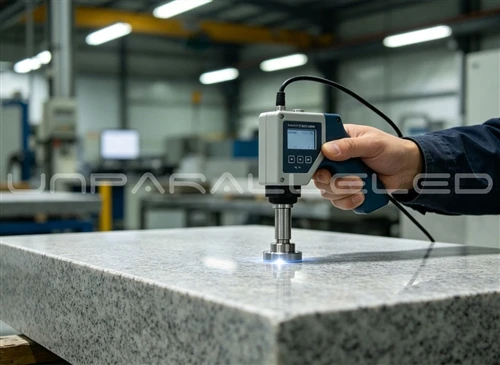
A claim of accuracy is only useful if it can be checked. Traceable metrology means that every flatness, straightness, parallelism and squareness figure on a report can be traced back through calibrated instruments to a national measurement standard. In practice this is a chain: the part is ground and hand-lapped; it is measured in a temperature-controlled room; the measurement is taken with calibrated equipment such as electronic levels, precision comparators and laser interferometers; and the resulting certificate records the instrument, its calibration status and the conditions of the measurement. Without that chain, two suppliers can both print "0.01 mm" and only one of them can defend the number.
Certifications and compliance that buyers can recognise
For international buyers, management-system certification is a quick way to check that a supplier is organised. UNPARALLELED® operates to ISO 9001 for quality management, ISO 45001 for occupational health and safety and ISO 14001 for environmental management, and its products are CE marked for the European market. These are not decoration: they describe a documented system for controlling processes, calibrating equipment, handling non-conformance and protecting the people who make and move very heavy stone. For a purchasing engineer, they are the difference between a supplier who can be audited and one who can only be trusted.
Protection and global presence
A brand is also a promise about where it can support you. UNPARALLELED® has built a registered trademark and patent portfolio covering key markets including the European Union, the United States and Southeast Asia, so customers in those regions can deal with a protected, accountable supplier rather than an anonymous trading name. That protection matters when a precision granite component is part of a machine you will support for a decade, across borders and through several generations of your own product.
What to ask before you specify
Specifying precision granite becomes simpler when the questions are made explicit. Ask what the material actually is, and for its measured density rather than a general description. Ask how the raw stone was screened and what process was used to release internal stress. Ask which instruments were used to measure flatness and straightness, and whether their calibration is traceable. Ask which certifications apply to the plant that will make your part. And ask whether the two surfaces you care about - the reference face and the mounting interface - are controlled together. A supplier who can answer these questions with documents is the one worth building a long-term relationship with.
Built to be verified
Density, stability and traceable metrology are not marketing terms. They are the three things that decide whether a precision granite structure still holds its accuracy years after installation. When UNPARALLELED® produces precision granite components and custom precision granite machine bases, the material is selected at about 3100 kg/m³, the geometry is measured on calibrated equipment with traceable certificates, and the whole process sits inside an ISO 9001, ISO 45001 and ISO 14001 management system. If you are specifying a base, a plate or a metrology reference, send us your drawing and requirements, and we will show you the material data and inspection records behind the number.