



Many production lines install coordinate measuring machines beside machining stations, where workpieces are delivered for inspection immediately after cutting. Suspended metal dust and cutting fluid mist continuously spread around the equipment. Though granite features dense texture, natural stone still contains micro pores. When exposed to oil mist and dust mixtures for extended periods, micro pores absorb emulsifiers and oil from cutting fluids. Metal particles easily embed into micro grooves on reference surfaces, gradually damaging air-floating motion pairs and triggering measurement fluctuations. Based on working conditions of workshop granite CMMs, UNPARALLELED Group provides a complete protection solution covering pre-treatment of granite components before delivery, physical isolation of the whole machine, air circuit protection and on-site maintenance specifications.
Vacuum pressure impregnation is applied to granite components before delivery as the primary internal protection. Ordinary polished granite appears smooth visually, yet numerous micro pores remain on the micro level. Once cutting fluid mist adheres, oil components penetrate pores and are hard to wipe away. Long-term oil residue causes surface discoloration, and partial moisture absorption induces tiny deformation. Low-viscosity stable resin penetrates and solidifies inside surface pores of stone under vacuum pressure. No thick film forms on reference surfaces, so flatness and straightness indicators stay unchanged. After impregnation, pores on granite are sealed. Cutting fluids cannot penetrate deep into the substrate; oil and coolant remain only on the surface, greatly simplifying cleaning work and reducing grain boundary erosion caused by long-term oil residue. This impregnation treatment is applied only on worktables and guide rail surfaces, without altering granite's inherent advantages of low thermal expansion and high damping. It is customized specially for workshop CMMs placed close to machine tools.
Physical isolation and local splash guards block coarse iron chips and splashing cutting fluid. Surface sealing of stone alone cannot resist massive splashing coolant and coarse chips, so customized protective structures are required. Independent dust enclosures can be built around measuring machines, with liquid diversion troughs at the bottom to collect and drain splashing cutting fluid and prevent liquid from flowing onto granite surfaces. Flexible dust curtains are fitted at workpiece loading and unloading ports to reduce dust entering the measuring chamber together with workpiece handling. For semi-open layouts adopted by some production lines, narrow liquid barrier strips are installed along edges of granite worktables to stop liquid seeping down to supporting structures along table edges. Isolation design balances protection and equipment heat dissipation. Fully sealed layouts must be avoided, as trapped heat creates local temperature gradients on granite and introduces measurement errors in turn.
Protection for air-floating systems and linear scales forms an easily overlooked core link. The biggest hazard of dust and oil mist is not direct corrosion of granite body, but particles entering gaps of air bearing film. Fine metal dust mixed with cutting fluid oil film forms an abrasive medium between air-floating guide rails and granite reference surfaces, gradually scratching ultra-precision reference planes. Multi-stage filters are added into compressed air pipelines. Apart from standard water removal, oil removal filters are installed to stop oil mist in air sources from entering air bearings. Transparent protective covers are fitted over linear scales and readheads to block dust and oil mist attaching to scale gratings. Water in air storage tanks and filters needs draining regularly. Once compressed air carries water, water vapor mixed with oil contaminates granite guide rails, accelerating aging of sealing layers and destabilizing air film.
Preprocessing of workpieces before loading serves as the checkpoint for on-site protection. Newly machined workpieces carry large amounts of cutting fluid and iron chips. Direct placement on granite worktables rapidly contaminates reference surfaces. A pre-cleaning station is set before the measuring position. Air guns blow off iron chips and cutting fluid is dried before workpieces enter the measuring zone. Operators should avoid touching granite guide rails with gloves contaminated by cutting fluid. If cutting fluid drips fall on the table, wipe immediately with lint-free cloth and neutral granite-compatible cleaner in one-way strokes. Liquid must not stay for long. Strong acid or alkaline detergents are forbidden, since they destroy impregnated sealing layers and damage stone grain boundaries.
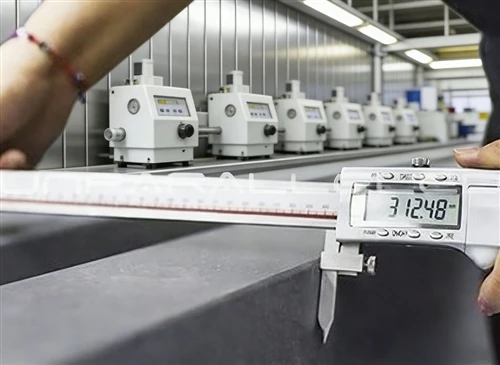
Periodic inspection and maintenance sustain the effectiveness of the whole protection system. Impregnated sealing layers are not permanently wear-proof. Repeated wiping and friction from hard particles gradually consume surface sealing structures. Regular inspection is scheduled according to operating frequency. Strong oblique light checks granite reference surfaces for oil absorption and dark discoloration. Once local failure of sealing layers is detected, partial re-impregnation repair can be performed. Meanwhile, inspect aging and cracking of enclosures and liquid barrier strips, and check whether filter pressure difference exceeds limits. During maintenance, steel brushes and hard scrapers are prohibited from cleaning table surfaces to prevent artificial scratches on benchmarks. Re-calibrate three-axis geometric accuracy after each maintenance round to confirm no hidden benchmark drift is caused by dust and oil contamination.
Protection schemes can be adjusted flexibly for different production line conditions. For workshops with mild oil mist and low dust levels, granite vacuum impregnation plus simple enclosures are sufficient. For heavy cutting scenarios with massive splashing cutting fluid, fully enclosed protective cabins, multi-stage air source filtration and regular sealing layer inspection are required. When delivering granite CMM components, UNPARALLELED evaluates on-site dust concentration and cutting fluid types for customers, recommending matching impregnation plans and protective structures, helping equipment maintain stable metrology benchmarks in harsh machining workshop environments.