



In the relentless pursuit of industrial excellence, the focus often falls on the most visible advancements: blazing-fast spindle speeds, nanometer-level optical sensors, or the intricate algorithms driving artificial intelligence. However, beneath the sleek exteriors of modern Computer Numerical Control (CNC) machines and the hyper-advanced lithography systems of the semiconductor industry lies a foundational hero that remains irreplaceable: the cast iron platform. Often dismissed as a traditional or even archaic material in the face of modern composites and ceramics, high-grade cast iron continues to serve as the structural backbone of precision engineering. Its unique combination of damping capacity, thermal stability, and structural rigidity makes it an indispensable element in achieving the ultra-high tolerances demanded by today's most sophisticated manufacturing sectors.
The Metallurgical Science of Stability
To understand why cast iron remains the material of choice for critical equipment bases, one must delve into its microstructure. Unlike steel, which is valued for its tensile strength, the specific grades of gray cast iron (such as HT250, HT300, and high-strength ductile iron) used in precision machinery are prized for their unique internal composition. The material contains microscopic flakes of graphite distributed throughout a metallic matrix. These graphite flakes act as millions of tiny, internal discontinuities that are exceptionally effective at interrupting the transmission of vibrational energy.
This phenomenon, known as damping capacity, is the defining characteristic that sets cast iron apart from fabricated steel structures. In high-speed CNC machining, the interaction between the cutting tool and the workpiece generates significant harmonic vibrations. If these vibrations are not absorbed, they manifest as "chatter," which ruins surface finishes, reduces tool life, and compromises geometric accuracy. A cast iron machine bed or platform acts as a massive vibration sink, dissipating this energy as negligible amounts of heat. This inherent ability to "quiet" the machine allows for smoother operations, finer surface finishes, and the ability to push cutting parameters to their limits without sacrificing precision.
Cast Iron in the Heart of CNC Machining
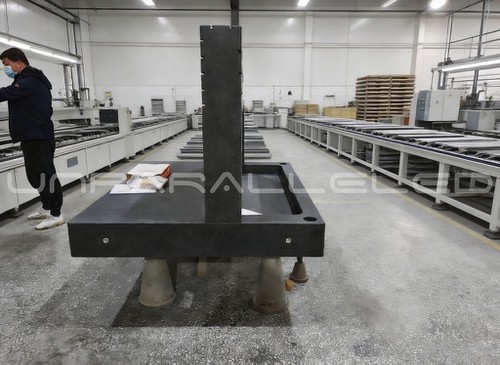
In the realm of CNC machining, the cast iron platform-whether in the form of a machine bed, a column, or a T-slot worktable-serves as the absolute reference point for all motion. The rigidity of the platform determines the machine's ability to resist deformation under heavy cutting loads. Modern casting techniques, such as resin sand molding, allow manufacturers to create complex internal ribbing structures (often optimized using topology optimization software) that maximize stiffness while managing weight.
Furthermore, the thermal characteristics of cast iron are vital for maintaining accuracy over long production runs. While all materials expand and contract with temperature changes, high-quality cast iron exhibits a predictable and relatively low coefficient of thermal expansion. When combined with proper aging processes-where the casting is heated and cooled slowly to relieve internal stresses-a cast iron base ensures that the machine's geometry remains stable over years, or even decades, of operation. This longevity is why top-tier machine tool builders continue to rely on heavily ribbed cast iron structures for their 5-axis machining centers and turning mills. It provides a "thermal anchor" that minimizes the drift caused by the heat generated by motors, drives, and the cutting process itself.
The Unexpected Role in Semiconductor Manufacturing
Perhaps the most surprising application of cast iron lies in the semiconductor industry, a sector typically associated with carbon fiber, ceramics, and exotic alloys. While the moving stages of a wafer scanner require extreme lightness, the foundational base of the equipment often relies on the sheer mass and stability of cast iron. In photolithography, where circuits are printed onto silicon wafers with features measured in single-digit nanometers, environmental vibration is the enemy.
Cast iron platforms in semiconductor equipment serve as passive vibration isolation bases. Their high mass, combined with their natural damping properties, creates a low-pass filter for floor vibrations. They effectively decouple the sensitive optical columns and wafer stages from the noisy environment of a fabrication plant (fab). Moreover, for the metrology tools used to inspect these wafers, cast iron provides a thermally stable platform that ensures measurement repeatability. In an industry where a deviation of a few nanometers can render a microchip useless, the cast iron base acts as the silent guardian of yield rates, ensuring that the multi-million dollar optics above it have a perfectly still canvas upon which to operate.
Precision Engineering and Craftsmanship
The effectiveness of a cast iron platform is not solely defined by the material itself, but by the craftsmanship applied to it. The journey from a rough casting to a precision surface plate or machine bed involves rigorous processing. Stress-relief annealing is a critical step, ensuring that the metal will not warp over time. Following this, the surfaces undergo precision grinding and, in high-end applications, manual scraping.
Hand scraping is an artisanal process where skilled machinists remove microscopic high spots to create a surface of perfect flatness. This process not only achieves geometric accuracy that machines sometimes cannot match but also creates a surface pattern of tiny pockets. These pockets retain oil, providing hydrodynamic lubrication that reduces friction and wear between the platform and the mating components. This synergy of ancient craft and modern metallurgy results in a component that is both durable and incredibly precise, capable of supporting loads ranging from a few kilograms in optical inspection to tons in heavy industrial assembly.
Conclusion
As manufacturing marches toward the era of Industry 4.0, characterized by smart factories and autonomous systems, the physical requirements for precision remain grounded in the laws of physics. The need to dampen vibration, resist thermal deformation, and provide a rigid geometric anchor has not disappeared; it has become even more critical. Cast iron platforms, with their unparalleled damping capacity and structural integrity, continue to be the bedrock upon which modern precision is built.
From the heavy-duty T-slot tables in automotive assembly lines to the massive, vibration-dampening bases of semiconductor lithography machines, cast iron proves that innovation is not always about finding new materials, but often about mastering the ones we already have. In the high-stakes world of ultra-precise measurement and manufacturing, the cast iron platform remains the definitive standard for stability, ensuring that the blueprint of the future is drawn on a foundation that never wavers.