



In the high-stakes world of modern manufacturing and scientific research, precision is not merely an aspiration; it is an absolute necessity. As industries push the boundaries of miniaturization and tolerance-particularly in semiconductor fabrication, aerospace engineering, and advanced optics-the foundational tools used for measurement must evolve to meet these rigorous demands. At the heart of this metrological evolution lies a material that has stood the test of geological time: granite. Granite surface plates, often referred to as the "silent guardians" of precision, have become indispensable in ultra-precise measurements. Their unique physical and chemical properties offer a level of stability and reliability that traditional materials, such as cast iron, simply cannot match in the most demanding environments.
The Geological Foundation of Precision
To understand why granite is the material of choice for ultra-precise measurement, one must first appreciate its origins. A high-quality granite surface plate is not a manufactured composite but a slice of the earth itself, quarried from deep underground layers of fine-grained igneous rock, such as gabbro, diabase, or high-grade granite. These materials have undergone hundreds of millions of years of natural aging and geological stress. This immense span of "natural aging" ensures that the internal stresses within the rock have completely dissipated long before the stone is ever cut.
Consequently, once a granite surface plate is precision-ground and polished to a mirror finish, it possesses an inherent structural stability that is nearly impossible to replicate artificially. Unlike metals, which can be prone to warping or shifting due to residual stresses from casting and machining, granite remains dimensionally constant. This geological heritage provides the "zero point" upon which modern precision measurement relies.
Unmatched Thermal Stability
One of the most critical challenges in ultra-precise measurement is the fluctuation of ambient temperature. In a machine shop or a laboratory, temperature shifts of even a few degrees can cause metal components to expand or contract, introducing significant errors into measurement data. This is where granite distinguishes itself as a superior engineering material.
Granite boasts an exceptionally low coefficient of thermal expansion-roughly one-third that of cast iron. This means that granite surface plates are remarkably resistant to the warping and dimensional changes that plague metallic surfaces during temperature fluctuations. For industries operating in environments where maintaining a strict 20°C constant temperature is difficult or expensive, granite offers a robust buffer against thermal drift. This thermal inertness ensures that a measurement taken in the morning remains consistent with one taken in the afternoon, regardless of minor environmental shifts. This characteristic is vital for maintaining the integrity of data in large-scale inspections and high-precision assembly lines.
Mechanical Superiority and Surface Integrity
The mechanical properties of granite further cement its status as the ideal datum for measurement. With a Mohs hardness of 6 to 7 and a Shore hardness exceeding 70, granite is significantly harder than cast iron or steel. This extreme hardness translates to exceptional wear resistance. A granite surface plate can withstand the constant sliding of instruments (precision instruments) and workpieces without developing the scratches, burrs, or raised edges that often plague softer metal plates.
Furthermore, the behavior of granite under stress is uniquely advantageous for metrology. If a granite plate is subjected to a heavy impact or an accidental collision, the brittle nature of the stone means it will likely chip or form a small depression (a concave pit) rather than raising a burr. In the context of precision measurement, a raised burr on a cast iron plate is catastrophic because it lifts the measuring instrument, skewing every subsequent reading. A small pit in a granite plate, however, leaves the surrounding surface perfectly flat, ensuring that the overall accuracy of the datum remains unaffected.
Additionally, granite has excellent vibration-damping properties. Its dense, non-metallic structure absorbs vibration effectively, which is crucial when using sensitive electronic measuring equipment. By isolating the measurement process from external vibrations, granite surface plates help achieve repeatable, high-resolution readings.
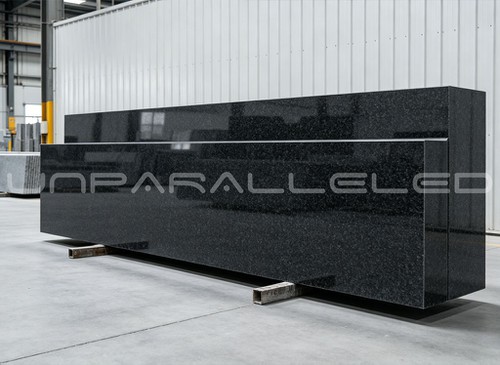
Chemical Inertness and Maintenance Efficiency
In the practical day-to-day operations of a busy workshop or laboratory, the maintenance of equipment is a significant factor in operational efficiency. Granite surface plates excel in this regard due to their chemical inertness. Being a non-metallic material, granite is completely immune to rust and corrosion. It does not require the application of protective oils or greases, which can attract dust and debris, potentially interfering with measurements.
This resistance extends to acids and alkalis, making granite plates suitable for use in environments where chemical exposure might be a concern. The non-porous surface, with an extremely low water absorption rate (typically less than 0.13%), ensures that the plate does not absorb moisture from the air, which could otherwise lead to swelling or distortion. Cleaning a granite surface plate is a straightforward process involving a simple wipe-down, saving technicians valuable time and reducing the total cost of ownership over the tool's lifespan.
Moreover, granite is non-magnetic. This is a critical feature for the electronics and semiconductor industries, where magnetic fields can interfere with the operation of sensitive sensors and measuring probes. A granite plate provides a neutral, non-interfering stage for these delicate operations.
The Role of Granite in High-Tech Industries
The application of granite surface plates extends far beyond general mechanical inspection. In the semiconductor industry, for instance, the manufacturing of microchips requires nanometer-level precision. Granite is used not only for surface plates but also for the structural bases of lithography machines, wafer inspection equipment, and coordinate measuring machines (CMMs). The material's ability to provide a stable, vibration-free, and thermally consistent platform is the backbone of the microchip manufacturing process.
Similarly, in the aerospace sector, where components must fit together with absolute perfection to ensure safety and aerodynamic efficiency, granite plates serve as the ultimate reference for calibrating complex geometries. From turbine blades to fuselage components, the accuracy of the final product is directly traced back to the flatness of the granite surface plate used during its inspection.
Conclusion
As manufacturing technologies continue to advance towards Industry 4.0, the demand for ultra-precise measurement will only intensify. While cast iron and other materials have their place in heavy-duty industrial applications, the specific requirements of high-precision metrology-thermal stability, mechanical hardness, chemical resistance, and long-term accuracy-make granite the undisputed champion.
Granite surface plates are more than just flat pieces of stone; they are sophisticated engineering tools derived from nature's own perfection. By providing an unyielding, stable, and accurate datum, they ensure that the innovations of today are built on a foundation of absolute truth. For any industry where precision is paramount, investing in a high-quality granite surface plate is not just an operational choice; it is a strategic necessity.